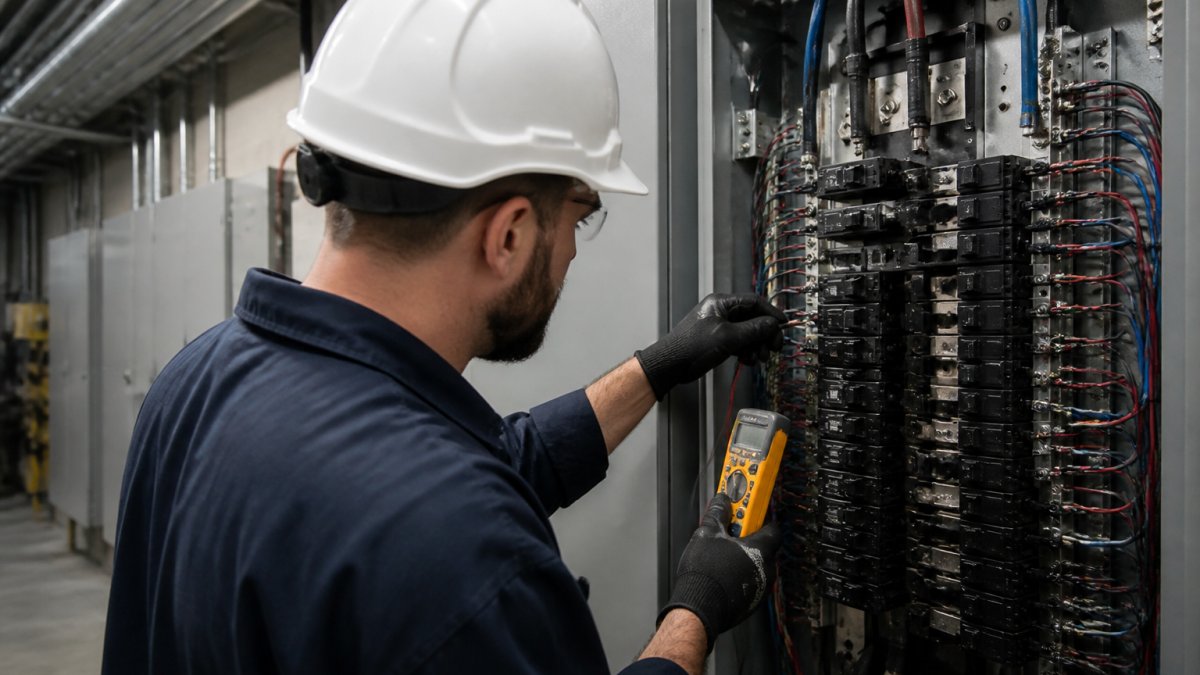
 how-to
Commercial Electrical Maintenance Services Pasco County
Table of Contents
- Commercial Electrical Maintenance Services in Pasco County: What Actually Keeps Your Building Running
- What a Commercial Electrical Inspection Checklist Should Cover
- Building a Commercial Electrical Maintenance Plan That Fits Your Facility
- Electrical Maintenance Schedule for Commercial Buildings: By Facility Type and Equipment
- Commercial Electrical Troubleshooting: Warning Signs and When to Call a Licensed Electrician
- Safety, Code Compliance, and Documentation for Business Facilities
- Maintenance Costs, Budgeting, and Choosing a Commercial Electrician
- Conclusion
- Frequently Asked Questions
Last Updated: October 5, 2026
Commercial Electrical Maintenance Services in Pasco County: What Actually Keeps Your Building Running
Commercial electrical maintenance services in Pasco County are the scheduled inspections, testing, and repairs that keep a business facility's electrical system safe and reliable between failures. At Costena Services, we've handled residential, commercial, industrial, and military electrical work across Tampa and Pasco County, leveraging over 35 years of industry experience. Buildings that run on a maintenance plan often avoid the outages and emergency bills that catch others off guard.
Below, we break down what a real maintenance program looks like, from the inspection checklist to the schedule, the warning signs, and the budgeting. Most guides stop at "call an electrician." That advice is useless until something already failed.
What a Commercial Electrical Inspection Checklist Should Cover
A commercial electrical inspection checklist is a documented walkthrough of every component that carries, controls, or protects power in your building. It should cover:
- Distribution panels and breakers, signs of heat, corrosion, loose lugs, and burned insulation
- Wiring and connections, exposed conductors, damaged conduit, and aging insulation
- Lighting fixtures and emergency lighting, function, output, and battery backup
- Grounding and bonding, integrity of the fault-current path
- Motors, HVAC disconnects, and dedicated circuits, amperage draw and overheating
- GFCI and AFCI protection, trip testing in wet and high-risk areas
The NFPA 70E standard for electrical safety in the workplace sets the framework most commercial inspections follow. A checklist without photos and readings is just a formality. Insist on both.
Building a Commercial Electrical Maintenance Plan That Fits Your Facility
A commercial electrical maintenance plan is a written schedule that assigns every inspection and service task a frequency, an owner, and a record. The useful version is a document you can hand to a new facility manager and have them run the building from day one.
Step 1: Build the asset inventory
Walk the property and list every component that carries, controls, or protects power, by location:
- Main service entrance, switchgear, and transformers
- Distribution panels and sub-panels, labeled by area served
- Motors, HVAC disconnects, and dedicated equipment circuits
- Lighting, emergency lighting, and exit signage circuits
- Grounding and bonding conductors
- GFCI and AFCI protected circuits
Record the panel schedule, breaker sizes, and the last known service date for each item. This inventory becomes the backbone of the plan.
Step 2: Assign frequency by risk, not by habit
Group tasks into tiers, then adjust each tier based on load, age, and how much downtime costs you:
- Monthly, visual checks, emergency lighting and exit sign tests, infrared spot checks on high-load panels, and a walk-through for heat, odor, or discoloration
- Quarterly, torque checks on critical connections, GFCI and AFCI trip testing, breaker exercising, and thermal imaging on distribution equipment
- Annual, full system inspection, load analysis, insulation resistance testing on older circuits, and a written condition report
- Event-driven, after a storm, a flood, a major equipment addition, or any breaker trip that repeats
A facility running three shifts on aging wiring should compress the quarterly tier toward monthly. A low-load office with newer construction can stretch it. The plan should say which is which, in writing.
Step 3: Name the owner and the trigger
The plan fails without two names: who calls the electrician, and who authorizes after-hours work. It also needs a written trigger list, what counts as an emergency call versus a scheduled visit. Burning smells, scorch marks, buzzing panels, and breakers that trip twice in a row are emergencies. A single flickering fixture is a scheduled visit.
Step 4: Store the records where they can be found
Inspection reports, thermal images, torque records, and repair invoices belong in one place, organized by panel and date. When an inspector, insurer, or buyer asks for proof of maintenance, a thin file is a liability. A labeled, dated file is due diligence.
If your facility has multiple buildings, older wiring, or equipment you have never fully mapped, that scope is exactly what we handle at Costena Services, and it is the kind of work that benefits most from a documented plan.
Electrical Maintenance Schedule for Commercial Buildings: By Facility Type and Equipment
The electrical maintenance schedule for commercial buildings varies by how the space is used. A warehouse with conveyor motors needs different attention than an office with server racks.
| Facility Type | Priority Equipment | Suggested Frequency |
|---|---|---|
| Office building | Distribution panels, lighting, HVAC disconnects | Quarterly visual, annual full inspection |
| Retail space | Signage circuits, POS power, emergency lighting | Monthly lighting check, quarterly panels |
| Warehouse or industrial | Motors, conveyors, high-bay lighting | Monthly motor checks, quarterly thermal scan |
| Restaurant or food service | Kitchen equipment circuits, GFCI protection | Monthly GFCI, quarterly panel inspection |
| Multi-tenant property | Main distribution, sub-panels, common area | Quarterly panels, annual full system |
Adjust the frequency based on load, age, and how critical uptime is to your operation.
Commercial Electrical Troubleshooting: Warning Signs and When to Call a Licensed Electrician
Call a licensed electrician immediately if you see burning smells, scorch marks, buzzing panels, or breakers that trip repeatedly after reset. Those are not "watch and see" symptoms. They're fire risks.
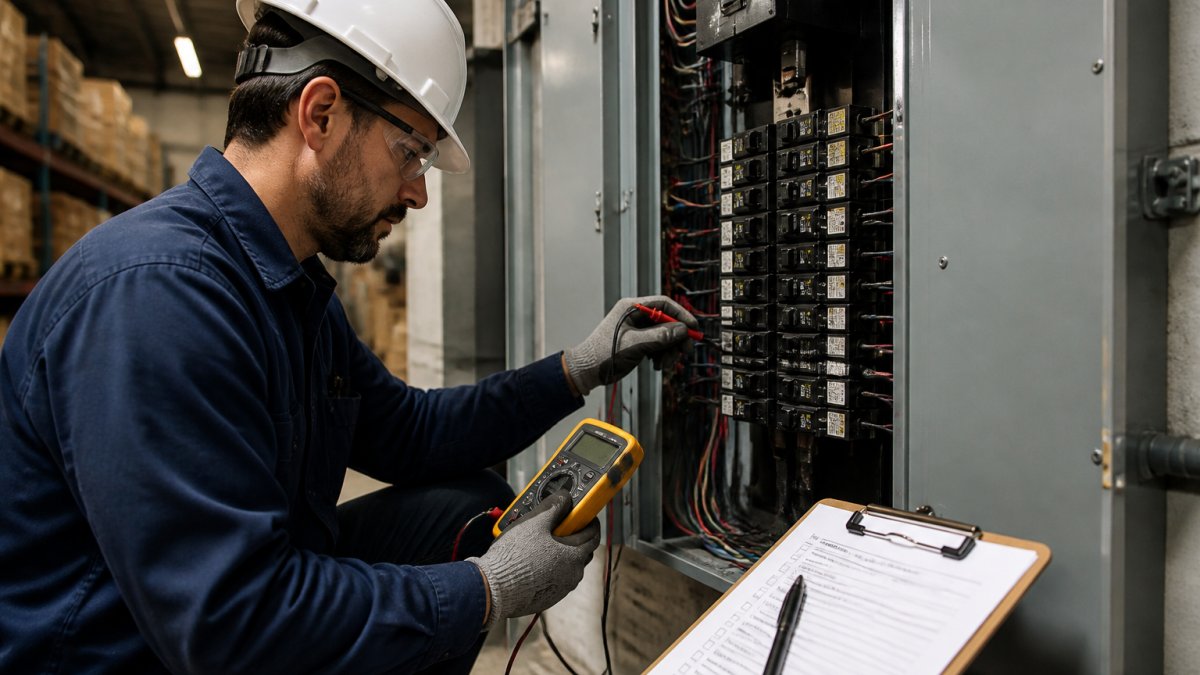
Other warning signs worth logging: flickering lights across multiple circuits, warm switch plates, discolored outlets, and a panel that hums louder than it used to. A common mistake is treating these as cosmetic. In practice, they usually mean a loose connection or an overloaded circuit, and both get worse with time.
Troubleshooting priority matters. Kill power to the affected area first, log what you saw and when, and don't open a panel yourself unless you're qualified. The log alone will cut your electrician's diagnostic time and your bill.
Safety, Code Compliance, and Documentation for Business Facilities
Code compliance is not a one-time event, and documentation is how you prove it. Keep inspection reports, thermal images, torque records, and repair invoices in one place, organized by panel and date.
The Occupational Safety and Health Administration guidance on electrical safety treats electrical hazards as a leading cause of workplace injury, and inspectors will ask for records. If you can't produce them, you can't demonstrate due diligence.
Documentation also protects you at resale, during insurance reviews, and when a tenant disputes a repair. A thin file is a liability.
Maintenance Costs, Budgeting, and Choosing a Commercial Electrician
Most service pages skip pricing entirely. You will not find a credible fixed number for commercial electrical maintenance, because cost depends on the building, not the calendar. What you can do is understand the drivers, build a budget that survives a surprise, and evaluate providers on the things that actually predict a good outcome.
What drives the cost of commercial electrical maintenance
- Building size and panel count, more distribution equipment means more inspection hours
- System age and condition, older wiring, aluminum branch circuits, and unlabeled panels take longer to inspect and document
- Equipment type, motors, conveyors, and kitchen equipment circuits require more testing than lighting and receptacles
- Access, ceiling access, occupied tenant spaces, and after-hours work all add labor
- Documentation depth, thermal imaging, torque records, and written condition reports cost more than a visual walk-through
- Urgency, emergency and after-hours calls carry a premium that scheduled work does not
How to build a maintenance budget
Separate the spend into three buckets and fund each one deliberately:
- Routine inspections, predictable, recurring, and the easiest line item to plan. Treat it as a fixed operating cost, not a discretionary one.
- Planned repairs and upgrades, panel upgrades, rewiring, and tenant buildouts are capital projects. Review them annually and flag anything that will need a permit or a shutdown window.
- Emergency reserve, a set-aside for the calls you cannot schedule. Facilities that skip routine maintenance tend to drain this bucket first.
A common pattern is that the emergency reserve shrinks every year a facility runs a real maintenance plan, and grows every year it does not.
How to evaluate a commercial electrical maintenance provider
Use this as a screening checklist before you sign anything:
- Are they licensed and insured, and will they provide the license number on request?
- Do they have commercial and industrial experience, not just residential?
- Will they price by the job so you know the total before work begins?
- Can they schedule around your operating hours without an automatic premium?
- Do they provide written inspection reports, thermal images, and torque records?
- What is their warranty if a repair fails after the work?
- What is their response time for an emergency call, in writing?
Why per-job pricing matters
We price by the job, not by the hour, so you know the cost before work begins. That model matters more than people realize. Per-job pricing puts the risk on the contractor to get it right the first time. When you compare providers, ask how they bill and what happens if the job takes longer than expected.
That is why we built Costena Services around upfront, per-job pricing and flexible scheduling. You get a clear number before we start, and we work around your operating hours.
Conclusion
Commercial electrical maintenance is most effective when it's scheduled, documented, and priced before the work begins. Reactive repairs can cost more, take longer, and put your building at risk.
Costena Services brings over 35 years of experience across residential, commercial, industrial, and military construction, with upfront pricing by the job and flexible scheduling that fits your operation. Get started with Costena Services and keep your building running on your terms.
Frequently Asked Questions
What does commercial electrical maintenance include?
It covers scheduled inspections of panels, wiring, outlets, lighting, and power distribution, plus tightening connections, thermal imaging, testing dedicated circuits, and documenting code compliance. For a business facility in Pasco County, it also includes checking equipment reliability and planning for upgrades or tenant buildouts before they become emergencies. A written commercial electrical inspection checklist keeps every visit consistent and gives property managers a record of what was checked and when.
How often should a commercial building have its electrical system inspected?
Most offices and retail spaces do well with annual inspections, while industrial sites, restaurants, and older buildings with heavy loads often need quarterly or twice-yearly service. The right frequency depends on equipment age, load, and how critical downtime is for your operation. A commercial electrical maintenance plan sets the interval based on your facility type, then adjusts after the first inspection reveals the actual condition of the system.
What are the signs a commercial electrical system needs maintenance?
Watch for flickering or dimming lights, warm or discolored outlets and switch plates, breakers that trip repeatedly, buzzing from panels, and rising energy bills without a usage change. Burning smells or scorch marks mean you should call a licensed electrician immediately rather than troubleshoot further. These signs often point to loose connections or overloaded circuits, and catching them early is far cheaper than replacing damaged equipment or shutting down a business facility.
How can businesses reduce electrical downtime?
Preventive maintenance, including scheduled inspections, thermal scans, and circuit testing, can help find problems before they cause outages. Keep spare breakers and lighting fixtures on hand for fast repairs, and document every service call so patterns are visible. Pairing a commercial electrical maintenance plan with a clear commercial electrical troubleshooting process means your team knows who to call and what to shut down first, which shortens outages when they do happen.