 Comparison
How to Choose Commercial Electrical Maintenance Over Emergency Repair
Last Updated: November 8, 2026
Quick Summary
Commercial electrical maintenance is planned, scheduled work that keeps wiring, panels, breakers and connections in good condition before they fail. Emergency repair is the unplanned call made after something has already stopped working. Planning ahead lets you choose the date, crew and scope, and avoids the two-to-three-times cost premium of emergency work.
- Emergency electrical work can cost two to three times standard billing, according to the cited 2026 guide.
- Maintenance lets you pick the date, the crew and the scope of work.
- A useful program combines visual inspection, thermal scans and breaker testing.
- Quarterly visual checks and an annual thermal scan and testing review form a workable baseline.
- Smoke, sparking or a shock incident are life-safety events: leave the area and call 911 first.
Table of Contents
- Commercial Electrical Maintenance vs Emergency Repair: The Core Difference
- What Commercial Electrical Maintenance Includes
- What Counts as an Electrical Emergency at a Business
- Signs of Electrical Problems in Commercial Buildings
- Commercial Electrical Maintenance Schedule and Checklist
- Commercial Power Outage Response Steps
- Booking Scheduled Maintenance for Your Wesley Chapel Property
- Frequently Asked Questions
Commercial Electrical Maintenance vs Emergency Repair: The Core Difference
Commercial electrical maintenance is planned, scheduled work that keeps wiring, panels, breakers and connections in good condition before they fail. Emergency repair is the unplanned call you make after something has already stopped working.
The difference is timing and control. Emergency repair takes those choices away, usually at the worst possible hour. Greg Beverly Services' 2026 guide on commercial electrical maintenance costs reports that emergency electrical work can cost two to three times standard billing.
Neither approach replaces the other entirely. Maintenance reduces the number of unexpected failures, but it cannot prevent every one. Equipment still wears out, and some faults appear without warning.
What Commercial Electrical Maintenance Includes
A commercial maintenance program combines routine observation, professional inspection and targeted testing. CDI Electric's guide to commercial electrical maintenance describes this approach as moving away from waiting for failures and toward scheduled, proactive checks.
In practice, a typical program covers:
- Visual inspection of panels, breakers and exposed connections for heat damage, corrosion or loose hardware
- Testing of breakers and high-load equipment under real operating conditions
- Checks on lighting circuits, outlets and emergency systems
- Documentation of findings so trends are visible from one visit to the next
Testing is where the real value sits. A breaker that trips occasionally, or a connection that runs warm, rarely looks alarming on a walkthrough. A thermal scan or a load test finds it.
Watch out: a maintenance contract that only lists "inspections" without specifying what gets tested or recorded gives you little to compare against later. Ask for the checklist before you sign.
What Counts as an Electrical Emergency at a Business
An electrical emergency is any condition that poses an immediate safety risk or stops your operations.
Tier 1, Call 911 first, then your electrician. These are life-safety events:
- Smoke, flames or a burning smell coming from a panel, outlet, fixture or wiring
- Sparking, arcing or crackling at electrical equipment
- A shock incident or anyone injured by electrical contact
- Water actively entering or pooling around a panel, disconnect or switchgear
- A downed or damaged service drop or meter base on the property
Leave the area, keep others back, and do not touch the equipment. Once emergency services are on the way, call your electrical provider.
Tier 2, Same-day emergency service. These stop operations or carry a real risk of escalating:
- A complete loss of power to part or all of the building after you have confirmed the utility is not the cause
- A main breaker that trips repeatedly and will not stay reset
- A breaker, disconnect or panel that is hot to the touch or discolored
- Burning odor at an outlet or switch with no visible smoke
- A commercial refrigeration, life-safety or IT circuit down during operating hours
Tier 3, Schedule the next available visit. These are inconvenient but not dangerous:
- Flickering lights in one room or on one circuit
- A single dead outlet or switch
- A breaker that trips occasionally under a known heavy load
- Flickering or dimming that spreads only when a specific piece of equipment starts
Watch out: a Tier 3 symptom that spreads, more fixtures flickering, a warm panel, a breaker that starts tripping more often, has moved up a tier. Treat the change as the signal, not the original symptom.
Permitting reality. Most emergency repairs that replace or alter wiring, panels or service equipment require a permit and inspection under Florida building code and local jurisdiction rules.
If someone is injured, or there is fire or smoke, leave the area and call 911 first. Then contact your electrical service provider.
Signs of Electrical Problems in Commercial Buildings
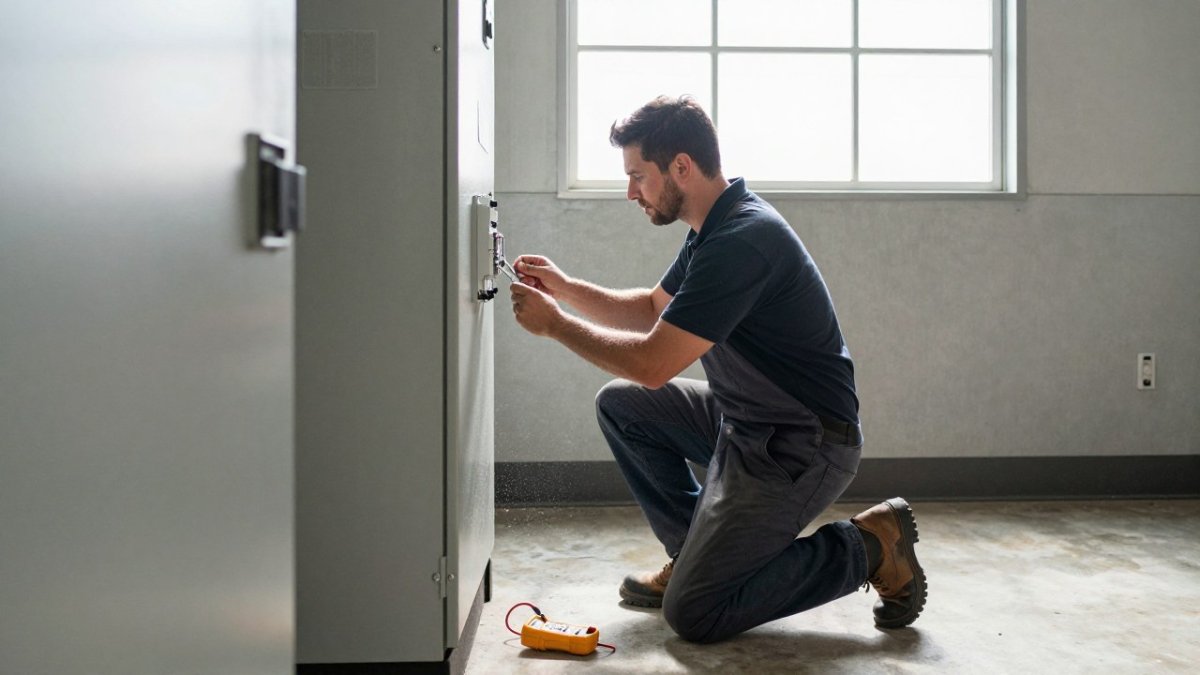
Commercial buildings usually give warning signs before a failure. Catching them early is the cheapest form of maintenance. A commercial electrician inspecting an open panel in a storage room, flashlight in hand, is the kind of visit that catches these early signs.
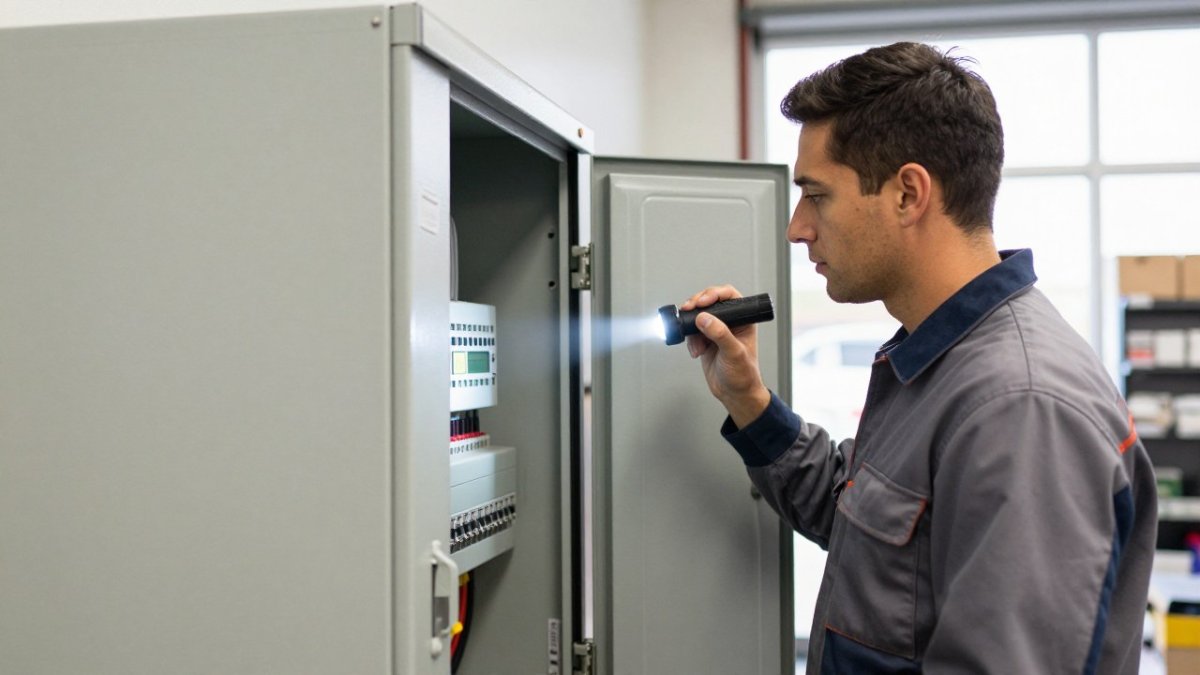
!Commercial electrician inspecting an open electrical panel in a retail storage room with a flashlight
Common warning signs include:
- Lights that dim when other equipment starts up
- Outlets or switches that feel warm to the touch
- Breakers that trip under loads they previously handled without trouble
- Discolored outlet covers or a faint burnt odor near panels
- Frequent bulb or ballast failures in the same fixtures
Any of these justify a scheduled inspection. For a deeper walk through troubleshooting, see our guide on electrical troubleshooting for commercial buildings.
Commercial Electrical Maintenance Schedule and Checklist
A maintenance schedule turns intention into routine.
A workable starting schedule
- Monthly: Function-test emergency lighting and exit signs; log any failures and replace batteries or units promptly.
- Quarterly: Visual inspection of panels, disconnects and exposed connections for heat damage, corrosion, loose hardware or debris; check that panel directories are accurate.
- Annually: Thermal scan of panels and high-load connections; breaker and protective-device testing per manufacturer guidance; review of the year's recorded trips, outages and repairs.
- Per manufacturer and code schedule: Testing of specific equipment such as GFCI and AFCI devices, motor controls and surge protective devices.
- After any storm, flood or major outage: A targeted inspection of service equipment, grounding and surge protection before returning to normal operation.
How property type changes the priorities
- Offices: Lighting circuits, receptacle loads and IT/server power dominate. Prioritize panel balance and dedicated circuits for critical equipment.
- Retail: Display lighting, POS circuits and after-hours security systems. Schedule inspections outside peak shopping hours.
- Restaurants: Kitchen equipment, exhaust fan circuits, refrigeration and high-heat connections. These run harder and warrant more frequent thermal checks.
- Warehouses and industrial: Motor loads, disconnects, conduit runs and high-amperage equipment. Vibration and dust accelerate connection wear.
- Multi-tenant buildings: Shared service equipment, tenant sub-panels and common-area life-safety systems. Coordinate access and document who is responsible for what.
What a usable checklist should record
A checklist is only as good as what it captures. Each visit should produce:
- Panel and disconnect locations inspected, with photos
- Thermal scan results, including any hot spots and their temperature differentials
- Breaker and protective-device test results
- Emergency lighting and exit sign test results
- Recorded trips, outages and repairs since the last visit
- Written findings with recommended repairs prioritized by urgency
- Technician name, date and scope of work
Keep these records.
Florida-specific scheduling considerations. Summer heat and humidity accelerate corrosion and connection wear, and storm season raises the value of post-storm inspections.
Watch out: a maintenance contract that lists "inspections" without specifying what gets tested, recorded or photographed gives you little to compare against later. Ask for the checklist and a sample report before you sign.
For how a formal agreement structures this recurring work, read our breakdown of commercial electrical maintenance contract benefits.
A workable maintenance cadence, drawn from the schedule this article lays out, looks like this:
| Interval | Task | Note |
|---|---|---|
| Monthly | Function-test emergency lighting and exit signs | Log failures; replace batteries or units promptly |
| Quarterly | Visual inspection of panels, disconnects and connections | Check for heat damage, corrosion, loose hardware |
| Annually | Thermal scan and breaker/protective-device testing | Review the year's recorded trips and repairs |
| Per manufacturer and code | Testing of GFCI, AFCI, motor controls and SPDs | Follow manufacturer and code schedules |
| After storms or major outages | Targeted inspection of service, grounding and surge protection | Complete before returning to normal operation |
Commercial Power Outage Response Steps
When power fails, the first few minutes matter more than the repair itself. A simple response plan keeps people safe and shortens downtime.
- Confirm the scope. Check whether the outage affects one room, one floor or the whole building. Check neighboring businesses to see if the utility is down.
- Stay safe. Do not touch exposed wiring or enter standing water near equipment. Keep people clear of the panel area.
- Check the obvious. Look for a tripped main or branch breaker. Reset it once. If it trips again, do not reset it a second time.
- Use backup power. Activate generators or emergency lighting if you have them, and follow their procedures.
- Call your provider. Give the exact time, the affected areas and any smell, sound or visible damage you noticed.
- Record everything. Note the times, affected equipment and what you did. This speeds diagnosis and supports any insurance claim.
Keep a printed copy of this plan at the front desk or in the facilities office. In an outage, nobody wants to search for it.
Booking Scheduled Maintenance for Your Wesley Chapel Property
Scheduling maintenance before a problem appears gives you the most options. You choose a window that avoids peak business hours, you can compare scope and cost in advance, and you avoid paying emergency rates.
Costena Services delivers residential, commercial, industrial and military electrical solutions across Tampa and Pasco County. If you want to plan maintenance for a Wesley Chapel commercial property, contact Costena Services to schedule your appointment and we will walk through the inspection scope with you.
If an emergency does happen, emergency electrician services in the Tampa Bay area are the right starting point for same-day response, and how to book a commercial electrical inspection explains what to prepare before the visit.
Prevention is cheaper than an outage. Start with one scheduled inspection, document what you find, and build the program from there.
Frequently Asked Questions
Is commercial electrical maintenance worth the cost?
Usually, yes. Maintenance spreads cost across planned visits and avoids the premium rates and lost operating time of emergency work. The exact savings depend on your building's age and load.
How often should a commercial building have its electrical system inspected?
Most programs include quarterly visual checks and an annual thermal scan and testing review. Follow the manufacturer's guidance and any applicable code requirements for your equipment.
What is the first thing to do during a commercial power outage?
Confirm the scope of the outage, keep people away from exposed wiring and water, and check for a tripped breaker. Reset it once only. If it trips again, call your electrical provider.
Frequently Asked Questions
What is the difference between commercial electrical maintenance and emergency repair?
Commercial electrical maintenance is scheduled, planned work: inspecting panels, testing breakers and connections, and checking high-load equipment before it fails. Emergency repair is unplanned work done after a failure has already caused an outage, a hazard or equipment damage. Maintenance is generally the lower-disruption, more predictable option, while emergency repair is necessary when something has already broken. Many Wesley Chapel businesses use a maintenance plan to reduce how often emergency calls happen, but no plan eliminates them entirely.
How often should a commercial building have its electrical system inspected?
Frequency depends on the size of the building, the age of its wiring, and how heavily its equipment is loaded. Many facility managers set a routine schedule with periodic professional inspections, supplemented by regular visual checks by staff. Costena Services can review your property and recommend a schedule that fits your operation; contact the company for an assessment rather than relying on a one-size-fits-all interval.
What electrical problems require emergency service at a business?
Call for emergency service when there is a burning smell, visible scorching, sparking outlets or panels, a tripped breaker that will not reset, a partial or complete loss of power, or any shock hazard. These conditions can threaten people and property and should not wait for a scheduled visit. Shut off power to the affected area only if it is safe to do so, and keep staff away from the equipment until a licensed electrician arrives.
What should a business do during a commercial power outage?
First, confirm whether the outage is limited to your building or affects the wider area. Keep staff away from exposed equipment, use flashlights rather than candles, and protect sensitive electronics by unplugging them when power returns, since surges can follow restoration. Record when the outage started and any equipment that failed, then contact a licensed electrician if the problem is inside your building. Keep a written outage plan so staff know these steps before an emergency happens.